
Last Updated on November 24, 2026 by Ideal Editor
🇹🇷 Turkish Citizenship Through Property Investment: Understanding the 2026 Valuation Rules
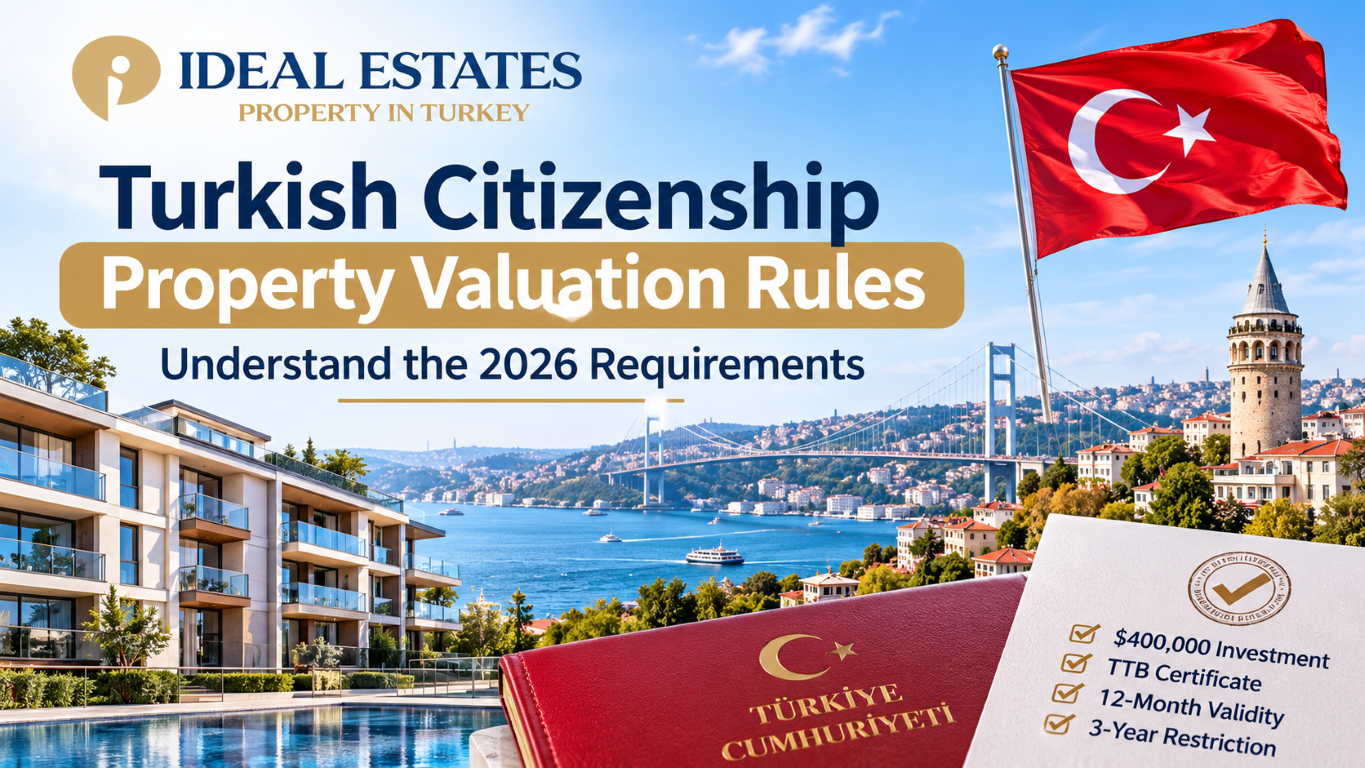
The Turkish Citizenship Property Valuation Rules 2026 have undergone important changes, making it essential for international investors to understand the latest requirements before purchasing real estate in Turkey. Although the minimum investment threshold remains $400,000, updated valuation procedures, the electronic Tutar Tespit Belgesi (TTB), and stricter financial verification requirements have changed how property investments qualify for Turkish citizenship.
For foreign investors considering buying property in Istanbul, Antalya, Alanya, Mersin, Bodrum or other popular Turkish destinations, understanding these regulations can make the difference between a successful citizenship application and an expensive investment that fails to meet the eligibility criteria.
The September 2026 regulatory changes have also introduced greater flexibility in property valuation procedures while maintaining the government’s emphasis on transparent transactions, independently verified property values and traceable payments.
This comprehensive guide explains the Turkish citizenship property investment requirements, the latest valuation procedures, the importance of the TTB certificate and the practical steps investors should take before committing their money.
📊 Turkish Citizenship by Investment: The $400,000 Requirement in 2026
The minimum property investment required to qualify for Turkish citizenship remains $400,000 or its equivalent in foreign currency.
This threshold applies to eligible property purchases made after 19 September 2018. It was originally increased from $250,000 to $400,000 in 2022.
However, meeting the financial threshold is not simply a matter of purchasing an apartment advertised for $400,000 or transferring that amount to a seller.
The authorities examine several elements of the transaction to establish whether the investment satisfies the legal requirements.
These include:
- The declared purchase price recorded in the official title deed (TAPU).
- The actual payments made to the seller, supported by banking documentation.
- The investment value established through the official property valuation and TTB process.
- Compliance with the applicable foreign currency conversion requirements.
The essential principle: The purchase price, documented payments and officially accepted investment value must be consistent with the applicable citizenship investment requirements.
For example, an investor purchasing an apartment for $420,000 may encounter difficulties if the accepted investment valuation establishes an eligible value below $400,000.
A higher advertised price or a larger payment cannot automatically compensate for an insufficient officially recognised investment value.
This makes preliminary valuation checks particularly important before signing a purchase agreement or transferring a deposit.
✅ What Changed in Turkey’s Property Valuation Rules on 28 September 2026?
One of the most significant developments in the Turkish citizenship investment programme took place on 28 September 2026.
The updated arrangements changed the requirements governing which valuation companies can prepare reports used in citizenship-related property transactions.
Previously, the valuation process operated under a more restrictive arrangement centred on GEDAŞ.
Under the updated framework, valuation reports can be prepared by other companies authorised by the Capital Markets Board of Turkey (SPK), subject to the applicable regulatory and electronic system requirements.
The changes provide investors with greater flexibility while preserving the official valuation verification process.
Key changes introduced in September 2026
1. Greater choice of valuation companies
The previous exclusive GEDAŞ arrangement has been replaced by a broader framework allowing appropriately authorised SPK valuation companies to participate.
2. Extended TTB validity
The period between the issuance of the TTB and the relevant citizenship-related Land Registry application has increased from six months to twelve months.
If the period exceeds twelve months, the underlying valuation report must be renewed.
3. Continued electronic processing
The valuation process remains integrated with WebTapu, TADEBİS and the Land Registry’s electronic systems.
Paper certificates presented independently by buyers or representatives are not a substitute for the required electronic submission.
4. Updated arrangements for real estate investment companies
Transactions involving Real Estate Investment Companies (GYO) are subject to specific valuation verification arrangements, including the use of qualifying reports published through the Public Disclosure Platform (KAP) or a new valuation report requested through WebTapu/TADEBİS.
These changes do not eliminate the requirement for independent valuation or reduce the minimum citizenship investment threshold.
💡 What Is Tutar Tespit Belgesi (TTB)?
The Tutar Tespit Belgesi (TTB) is an official electronic document establishing the property investment amount that can be recognised for Turkish citizenship purposes.
It plays a central role in verifying whether a property purchase meets the financial requirements of the citizenship programme.
Unlike a conventional property valuation report, the TTB specifically identifies the investment amount that can be accepted under the citizenship regulations.
Why is the TTB important?
The TTB helps the Land Registry authorities verify:
- Whether the property meets the minimum investment requirements.
- Whether the valuation supports the declared transaction.
- Whether the investment can be recognised for citizenship purposes.
- Whether the relevant financial documentation supports the application.
A property may have a high market asking price, but this does not automatically establish its eligibility.
The officially recognised investment amount is what matters.
How is the TTB issued?
The process generally follows these stages:
1. Property identification: The property is identified and its legal registration details are checked.
2. Valuation request: A citizenship-specific valuation request is submitted through WebTapu/TADEBİS.
3. Professional appraisal: An appropriately authorised valuation company assesses the property.
4. Electronic TTB preparation: The investment amount is established through the designated electronic system.
5. Land Registry transmission: The relevant documentation is transmitted electronically to the Land Registry system.
6. Citizenship eligibility assessment: The investment amount is considered alongside the purchase price, payment records and other legal requirements.
Investors should understand that a privately obtained valuation report does not automatically replace the official TTB process.
⚠️ The 12-Month Property Valuation Validity Rule
The September 2026 changes extended the TTB validity period from six months to twelve months.
This is an important operational improvement for foreign buyers who need additional time to complete property transactions and prepare their citizenship applications.
Under the updated arrangement:
- The relevant TTB must be within twelve months of the citizenship-related Land Registry application.
- If the twelve-month period expires, the underlying valuation report must be renewed.
- Changes to the property’s legal registration or circumstances affecting its valuation may also require a new assessment.
For example, an investor receiving a TTB in November 2026 should plan the relevant Land Registry application within the following twelve-month period.
Waiting until the last moment can create unnecessary administrative complications.
Practical advice: Arrange the valuation and purchase timetable together rather than treating them as separate activities.
📊 The Three-Part Financial Verification Process
One of the most important considerations when buying property for Turkish citizenship is ensuring that the financial documentation is consistent.
The authorities examine the transaction through three interconnected elements.
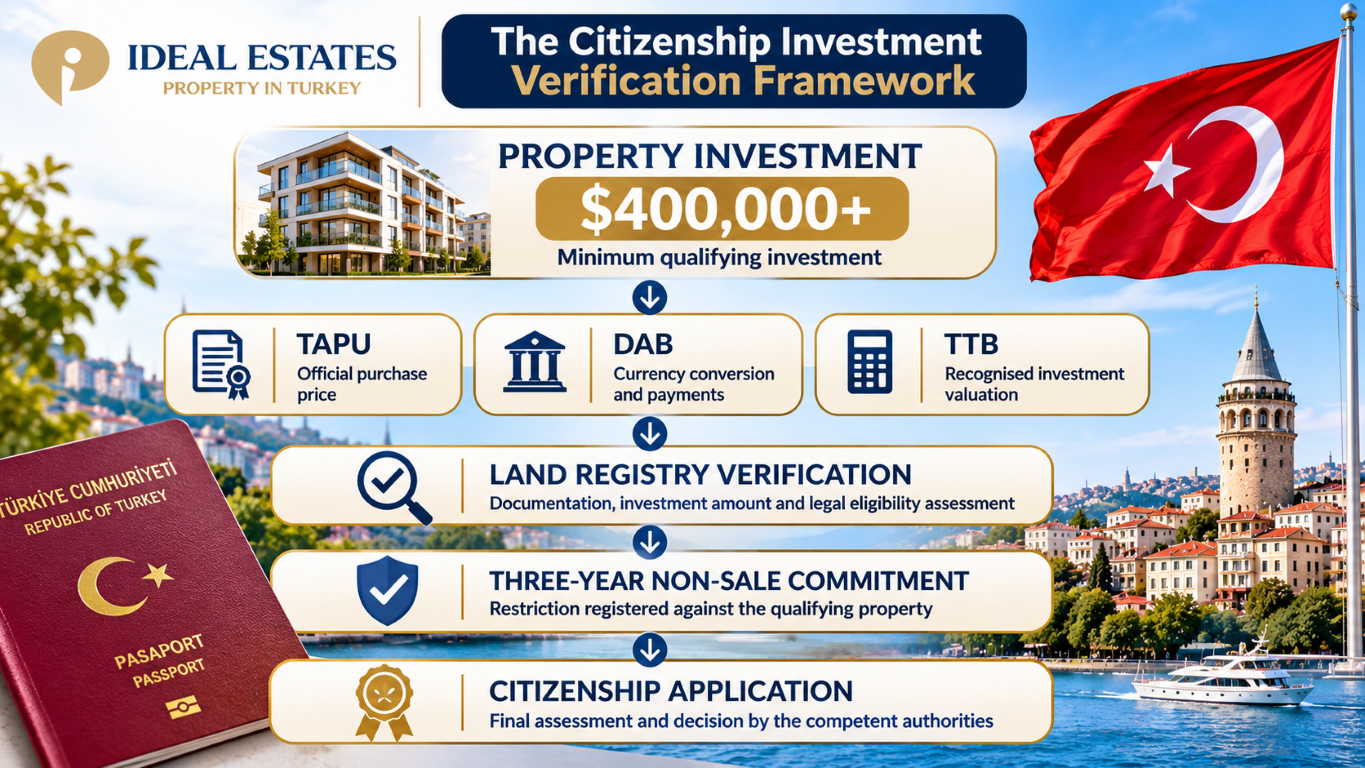
A. Official purchase price
The purchase price must be correctly declared in the official Land Registry documentation or qualifying notarised sale promise agreement.
The declared amount must satisfy the applicable minimum investment requirement.
B. Bank payments and Döviz Alım Belgesi (DAB)
The property payment must be supported by appropriate banking documentation.
The foreign currency amount must be sold through a bank for transfer to the Central Bank of Turkey in accordance with the applicable foreign currency conversion procedure.
The bank issues the Döviz Alım Belgesi (DAB).
Relevant payment receipts must also demonstrate that the seller or another legally recognised recipient received the required funds.
C. Official TTB investment valuation
The TTB establishes the investment amount recognised for citizenship purposes.
The valuation must support the minimum qualifying investment, taking account of the applicable documentation and regulatory rules.
Why all three elements matter
Consider the following hypothetical example:
An investor purchases an apartment for $430,000 and transfers the full amount through the banking system.
However, the officially recognised investment valuation is only $385,000.
Despite the higher purchase price and completed transfer, the investment may fail to qualify because the accepted valuation does not establish the required minimum.
This illustrates why investors should never rely exclusively on the developer’s advertised price.
🏠 Which Properties Qualify for Turkish Citizenship in 2026?
Not every property available on the Turkish real estate market automatically qualifies for citizenship investment.
The legal classification and registration status of the property are important.
Under the applicable regulations, qualifying properties generally include:
- Apartments registered as independent units under condominium ownership (Kat Mülkiyeti).
- Properties with condominium construction easement registration (Kat İrtifakı).
- Registered land with a compliant permanent building and the required occupancy documentation.
Certain types of land and property rights are excluded.
For example, undeveloped land subject to development obligations and agricultural land cannot automatically be used for citizenship qualification.
Timeshare rights are also excluded.
Important property eligibility considerations
Before purchasing, investors should verify:
Title deed status: The property must have an appropriate legal registration.
Occupancy permit: Where required, the building must have the necessary occupancy documentation (İskan).
Ownership structure: The investment cannot rely on an ordinary fractional or shared ownership arrangement.
Seller eligibility: Transactions must comply with restrictions concerning purchases from foreign individuals and foreign-controlled entities.
Previous citizenship use: A property already used by another foreign investor for citizenship qualification cannot simply be reused.
These checks are particularly important in resale transactions and properties offered through private sellers.
Can You Purchase Multiple Properties to Reach $400,000?
Yes. Turkish citizenship regulations allow investors to combine eligible properties to reach the minimum investment threshold.
For example:
An investor may purchase:
- Apartment A: $220,000.
- Apartment B: $180,000.
Total investment: $400,000.
However, the individual properties must satisfy the applicable legal and valuation requirements.
For purchases through separate title deed transactions, all relevant properties should be submitted together for the citizenship investment assessment so that the required three-year restriction can be properly registered.
It is also important to distinguish between purchasing multiple independent properties and purchasing a fractional share in one property.
The latter does not ordinarily qualify.
Can family members combine their property investments?
The citizenship investment threshold is assessed in relation to the individual applicant.
Properties purchased in the names of a spouse, children or other relatives cannot simply be added to the applicant’s investment total.
The property investment must satisfy the ownership and eligibility requirements applicable to the individual seeking citizenship.
⚠️ The Three-Year Property Holding Requirement
A fundamental condition of Turkish citizenship through property investment is the three-year non-sale commitment.
The investor must undertake not to sell the qualifying property for at least three years.
This commitment is registered as a restriction on the title deed.
The Turkish term commonly used for this restriction is Satılamaz Şerhi.
During the restriction period, the investor cannot freely dispose of the property in a manner that breaches the registered commitment.
This requirement should be considered when evaluating the investment’s financial attractiveness.
What happens after three years?
Once the required three-year period has been completed, the investor may generally sell the property, subject to the applicable legal and administrative procedures.
The completion of the restriction does not automatically cancel other legal obligations, taxes or contractual commitments.
Investors should also consider that property ownership involves ongoing costs, including:
- Annual property tax.
- Building maintenance charges (Aidat).
- Insurance.
- Property management expenses.
- Potential rental income taxation.
These costs should form part of the overall investment calculation.
📊 Old vs New Turkish Citizenship Valuation Rules
The September 2026 changes have made the valuation process more flexible.
The following comparison summarises the main differences.
| Requirement | Previous framework | Updated 2026 framework |
|---|---|---|
| Minimum investment | $400,000 | $400,000 |
| Valuation companies | GEDAŞ-centred exclusive arrangement | Other appropriately SPK-authorised companies permitted |
| TTB validity | 6 months | 12 months |
| Electronic submission | Required | Required |
| Paper TTB acceptance | Not accepted | Not accepted |
| GYO transactions | Specific TTB exemption | KAP report or new TTB valuation route |
| Three-year restriction | Required | Required |
| Financial verification | Required | Required |
The most important distinction is that the updated rules change the valuation administration rather than the fundamental citizenship investment requirements.
💡 What Is the Special Rule for GYO Properties?
GYO stands for Gayrimenkul Yatırım Ortaklığı, meaning Real Estate Investment Company.
These companies operate under Turkey’s capital markets framework and may sell properties directly to investors.
The September 2026 arrangements introduced specific procedures for citizenship-related sales involving these companies.
The relevant valuation verification can be supported through two routes:
Option 1: KAP valuation report
A qualifying valuation report prepared under the applicable capital markets requirements and published through the Public Disclosure Platform (KAP) can be submitted.
The report must contain the relevant property’s valuation information.
Option 2: New TTB valuation
The seller or relevant parties can request a new citizenship-specific valuation report through WebTapu/TADEBİS.
Where technical discrepancies arise, the Land Registry authorities may refer the documentation to the relevant department for assessment.
Investors purchasing from a GYO should establish which route applies before completing the transaction.
The Property Investment Process: Step-by-Step Framework
Buying property for Turkish citizenship involves several stages.
Understanding the correct sequence helps reduce financial and administrative risks.
Your 2026 citizenship investment roadmap
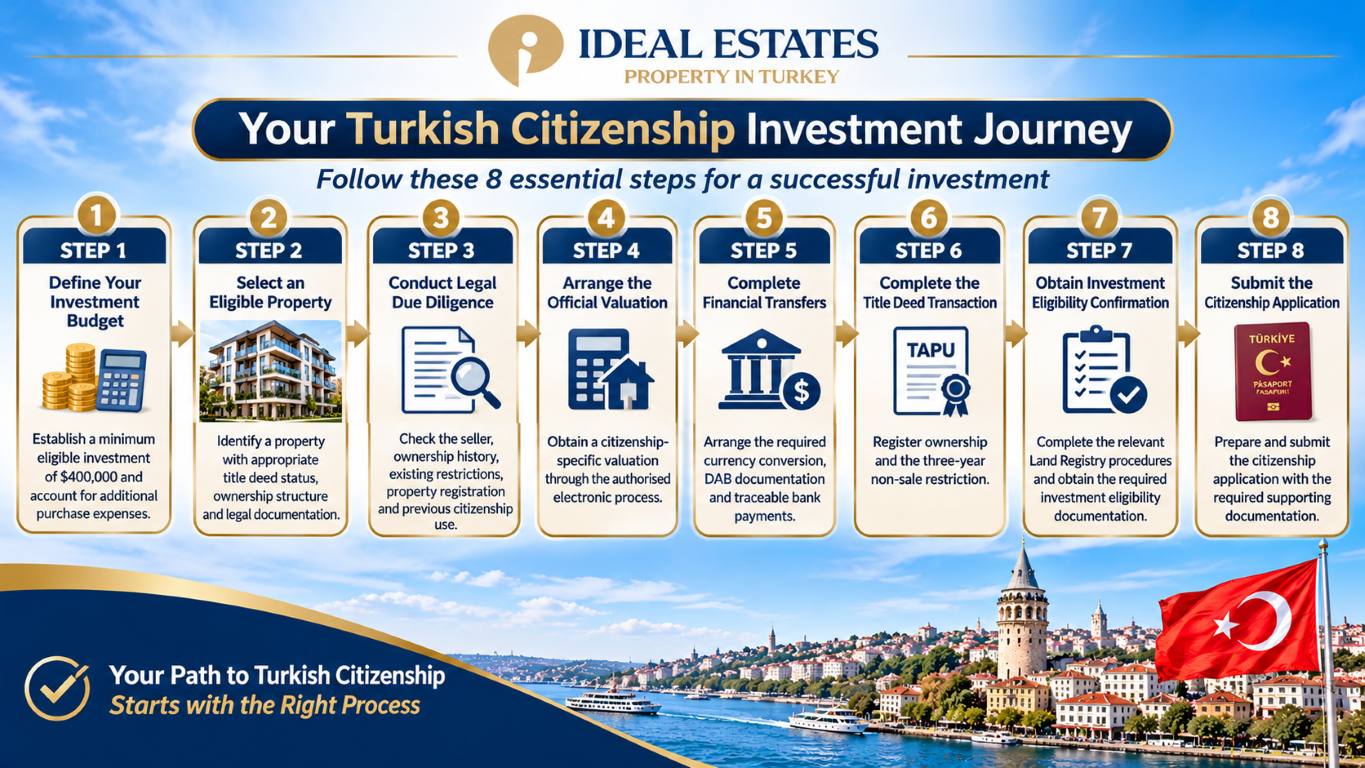
Investment objective: A legally compliant $400,000 property investment supported by the required valuation and financial documentation.
Essential Documents for Turkish Citizenship Through Property
Preparation is an important part of a successful application.
Although individual cases may require additional documents, investors should generally prepare the following:
Property documentation
- Official title deed (TAPU).
- Property identification and registration information.
- Relevant valuation report.
- Electronic TTB documentation.
- Occupancy permit where applicable.
Financial documentation
- Bank transfer receipts.
- Döviz Alım Belgesi (DAB).
- Purchase agreement or official sale documentation.
- Evidence of the payments made to the seller.
Personal documentation
- Valid passport.
- Certified translations where necessary.
- Birth certificate.
- Marital status documentation.
- Biometric photographs.
- Appropriate application forms.
- Power of attorney, where applicable.
Foreign documents may require apostille certification or consular legalisation, depending on the issuing country and applicable arrangements.
⚠️ Common Mistakes That Can Jeopardise a Citizenship Application
Even investors with sufficient financial resources can encounter problems when the transaction is not structured correctly.
The following mistakes deserve particular attention.
1. Relying on the advertised property price
A developer’s asking price does not establish the officially accepted investment value.
Always assess the property’s eligibility before making a financial commitment.
2. Ignoring the TTB process
A conventional appraisal report does not automatically satisfy the citizenship-specific electronic verification requirements.
3. Using incorrect payment channels
Cash payments and inadequately documented transfers can create serious problems.
Use the prescribed banking procedures and retain all supporting documentation.
4. Purchasing an ineligible property
Properties with unsuitable title deed classifications, ownership structures or legal restrictions may not qualify.
5. Overlooking the seller’s legal status
Transactions involving foreign sellers or foreign-controlled companies can be subject to restrictions.
6. Failing to coordinate multiple purchases
When combining several properties, the relevant title deed transactions must be structured and submitted in accordance with the applicable rules.
7. Assuming citizenship approval is automatic
Meeting the investment threshold is only one part of the process.
The authorities must still assess the applicant, the property and the supporting documentation.
Why Turkey Remains Attractive for International Property Investors
Turkey continues to attract international real estate buyers because of its geographical position, established residential markets, tourism industry and diverse property investment opportunities.
Different cities offer different advantages depending on an investor’s objectives.
Istanbul: International business and metropolitan living
Istanbul attracts investors interested in a major metropolitan property market.
Its international business environment, transport infrastructure, universities and diverse residential districts create opportunities across different property segments.
Antalya: Coastal lifestyle and established tourism
Antalya is popular among international buyers seeking coastal living, holiday homes and potential rental opportunities.
Its established tourism infrastructure supports demand across several residential and hospitality-related property segments.
Alanya: International residential demand
Alanya has developed into an internationally recognised residential destination.
Its Mediterranean climate, coastal environment and range of modern apartment developments make it particularly attractive to overseas buyers.
Mersin: Emerging residential opportunities
Mersin offers a different property market profile, with coastal developments, residential projects and comparatively varied price segments.
Investors should evaluate each location according to property quality, legal eligibility, rental demand and long-term resale prospects rather than relying solely on headline prices.
How Ideal Estates Helps Investors Navigate the 2026 Regulations
Purchasing Turkish property for citizenship involves more than selecting an attractive apartment.
The investment must satisfy the legal, valuation and financial requirements established by the Turkish authorities.
Ideal Estates supports international buyers throughout the property selection and purchasing journey.
Our approach focuses on helping investors identify suitable real estate opportunities while understanding the documentation and eligibility requirements associated with citizenship investment.
Our assistance can include:
- Identifying properties that meet the relevant citizenship investment criteria.
- Comparing residential developments and investment locations.
- Coordinating property viewings and purchase arrangements.
- Helping buyers understand title deed and property documentation.
- Supporting communication with relevant legal and valuation professionals.
- Assisting with the practical stages of the purchasing process.
- Providing guidance on property ownership and after-sales arrangements.
Every property should undergo appropriate legal and valuation checks before a buyer commits to the transaction.
Our objective is to make the Turkish property purchasing experience more transparent, organised and informed for international investors.
📊 Quick Comparison: Turkish Citizenship Property Investment
| Investment consideration | 2026 requirement |
|---|---|
| Minimum property investment | $400,000 |
| Official valuation | Required for citizenship investment |
| TTB validity | 12 months |
| Payment documentation | Required |
| Currency conversion | Applicable DAB procedure |
| Ownership restriction | 3 years |
| Multiple properties | Permitted, subject to conditions |
| Fractional ownership | Not eligible |
| Citizenship approval | Subject to government assessment |
💡 Structured Breakdown: The Citizenship Investment Verification Framework
Five Frequently Asked Questions
1. How much property investment must you make to qualify for Turkish citizenship in 2026? You must invest at least $400,000 or the equivalent in foreign currency to qualify for Turkish citizenship through property investment. You must also ensure that the authorities recognise your purchase price, verify your bank payments and approve your official property valuation.
2. What is the new Turkish citizenship property valuation rule for September 2026? On 28 September 2026, the updated regulations allowed SPK-authorised valuation companies to prepare citizenship-related property valuation reports, removing GEDAŞ’s exclusive role. The authorities also extended the TTB validity period from six to twelve months.
3. How long is a TTB certificate valid for Turkish citizenship? Under the updated September 2026 rules, the period between TTB issuance and the relevant citizenship-related Land Registry application cannot exceed twelve months. An expired valuation requires renewal.
4. Can foreigners buy multiple properties to qualify for Turkish citizenship? Yes. Foreign investors can combine multiple eligible properties to reach the $400,000 threshold. However, all properties must satisfy the applicable legal and valuation requirements, and the transactions must be submitted appropriately for the three-year restriction.
5. Can I sell my Turkish property after obtaining citizenship? The qualifying property must remain subject to a three-year non-sale restriction. Once this period has been completed, the property can generally be sold, subject to applicable legal and administrative requirements.
🇹🇷 Ready to Invest in Turkish Property and Obtain Citizenship?
Turkey offers international investors an opportunity to combine property ownership with a potential pathway to citizenship.
However, the 2026 valuation changes make choosing the right property and structuring the transaction correctly more important than ever.
At Ideal Estates, we help international buyers explore Turkish real estate opportunities, identify suitable investment properties and navigate the purchasing process with greater confidence.
Whether you are considering a luxury apartment in Istanbul, a Mediterranean residence in Antalya, a sea-view property in Alanya or a modern investment opportunity in Mersin, our team is ready to assist.
Start your Turkish property investment journey with Ideal Estates today.
Contact Ideal Estates to explore eligible property opportunities, arrange a personalised property consultation and take the first step towards owning real estate in Turkey.
Ideal Estates — Your Trusted Partner in Turkish Real Estate.
